
Television cameras captured the moment the war arrived in the UAE on Saturday as thick plumes of dark smoke rose over the emirate of Fujairah after Iranian ballistic missiles struck the coastal hub. Oil-loading operations at one of the world’s busiest ship-refuelling ports were suspended, and Iran’s military broadcast warnings for residents near ports and US installations to leave the area. The strikes marked a significant expansion of the conflict, bringing Iran’s military campaign directly to the doorstep of one of the Gulf’s most economically vital states.
The UAE had largely tried to stay on the sidelines of the US-Iran conflict that erupted on February 28. But Iran’s strategy of striking American allies and partners to raise the economic and political cost of the ongoing offensive brought the country into the front line. The UAE’s diplomatic adviser to the president condemned the attack as “terrorist aggression” while maintaining that the country still prioritised restraint and was seeking a diplomatic way out for both Iran and the region.
The broader conflict continued to intensify around the same time. US planes bombed Kharg Island again on Saturday following Friday’s major assault. President Trump said in public statements the island had been effectively demolished and hinted more strikes were possible. He called on China, France, Japan, South Korea, and the UK to send warships to the Strait of Hormuz, which Iran had blocked since the war began. Energy analysts warned that the combination of the Hormuz closure and Kharg Island strikes was pushing oil prices toward a potentially catastrophic level of $150 per barrel.
Iran kept up pressure on all fronts simultaneously. It fired rockets at Israel while launching missiles at the UAE, and its military threatened strikes on any facility in the Gulf with American ties. The foreign minister demanded Arab governments expel US forces. At the same time, Israel conducted dozens of airstrikes inside Iran, killing at least 15 people in Isfahan in a strike on a factory. US Defence Secretary Pete Hegseth said Iran’s leaders were “desperate and hiding,” while analysts noted the regime remained capable of sustained military operations.
The war’s human toll was staggering across the region. More than 1,400 Iranians had reportedly been killed in the bombing campaign. Thirteen Israelis had died, and roughly 20 people across the Gulf. Lebanon’s suffering continued, with over 800 killed and 850,000 displaced from Israeli strikes on Hezbollah. Six US troops died in a military aircraft crash in Iraq. The US embassy in Baghdad was struck by missiles, and Americans throughout Iraq were ordered to leave immediately. With Trump refusing to negotiate and no ceasefire talks under way, the world was watching a conflict that seemed intent on escalating further.
Dark Smoke Over Fujairah: The Moment Iran Brought the War to the UAE
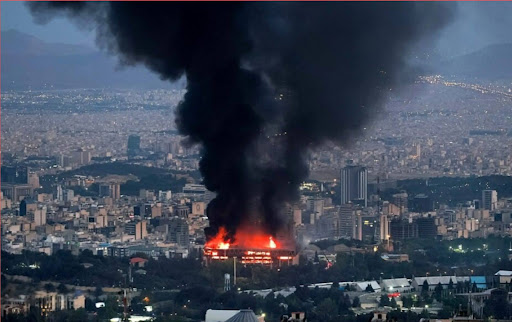
Photo by Mohammad Bornu / Avash Media / Wikimedia Commons (CC BY 4.0)
72