
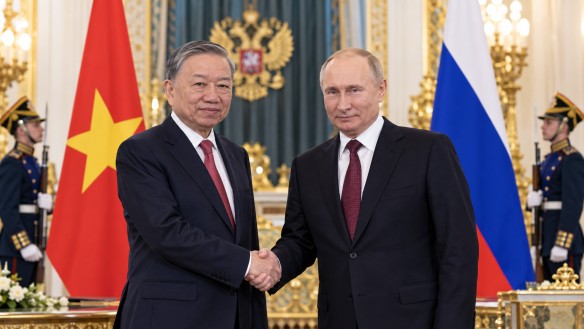
Russian President Vladimir Putin officially welcomed Vietnam’s General Secretary and President, Tô Lâm, along with his spouse Ngô Phương Ly, during a ceremony held at the Kremlin in Moscow. This event was part of the Vietnamese leader’s ongoing state visit to Russia, underscoring the long-standing friendship between the two nations. The ceremony took place in the historic St George’s Hall of the Grand Kremlin Palace, where both leaders exchanged greetings and the national anthems of Vietnam and Russia were played. Following this, they introduced members of their respective official delegations.
After the formalities, Tô Lâm and Putin engaged in talks and participated in the signing of bilateral cooperation documents. They later addressed the media, highlighting the deep-rooted political relationship characterized by significant trust between their countries. For over 75 years, Vietnam and Russia have maintained a strong partnership, frequently engaging in high-level exchanges and collaborating through multilateral organizations and international forums.
The scope of bilateral cooperation has broadened to include cultural exchanges, scientific and technological collaboration, and people-to-people interactions. Scientific and technological cooperation is emerging as a promising new pillar in their comprehensive strategic partnership. Additionally, the Vietnamese community residing in Russia plays a crucial role in enhancing the ties between the two countries.
Tô Lâm’s visit to Russia emphasizes Vietnam’s commitment to its traditional friendship and comprehensive strategic partnership with the Russian Federation. It also aligns with Vietnam’s foreign policy goals of independence, self-reliance, diversification, and multilateralization. During this visit, both sides are expected to discuss expanding cooperation in several key areas such as energy, science and technology, human-resource development, and infrastructure. Discussions will also focus on long-term strategic priorities and strengthening bilateral relations to meet the developmental objectives of both nations.